A commission that wasn't normal
I was asked to write a piece for Ash Wednesday in Munich Cathedral. Ash Wednesday is the beginning of Lent — traditionally a reminder of mortality, of ashes and dust. I never understood it as a purely bleak idea. For me it was always more about becoming aware of the time we actually have on this earth. And that was the thing I wanted to make feelable through music. Which left me with a strange question: what kind of piece do you even write for something like that?
What is "ashes", in sound?
The first problem was how to represent ashes musically. I even asked ChatGPT how it would define ashes. It wasn't much help — it told me ashes are what remains after a fire has done its work. Which, fine, but there is more to it. Ashes are the leftover of something that was once alive and is now completely useless. And that reminded me of the technology we live with, because technology has a much faster life cycle than a human being. So I thought: why not take something clearly outdated and build the piece around it.
The basement cupboard
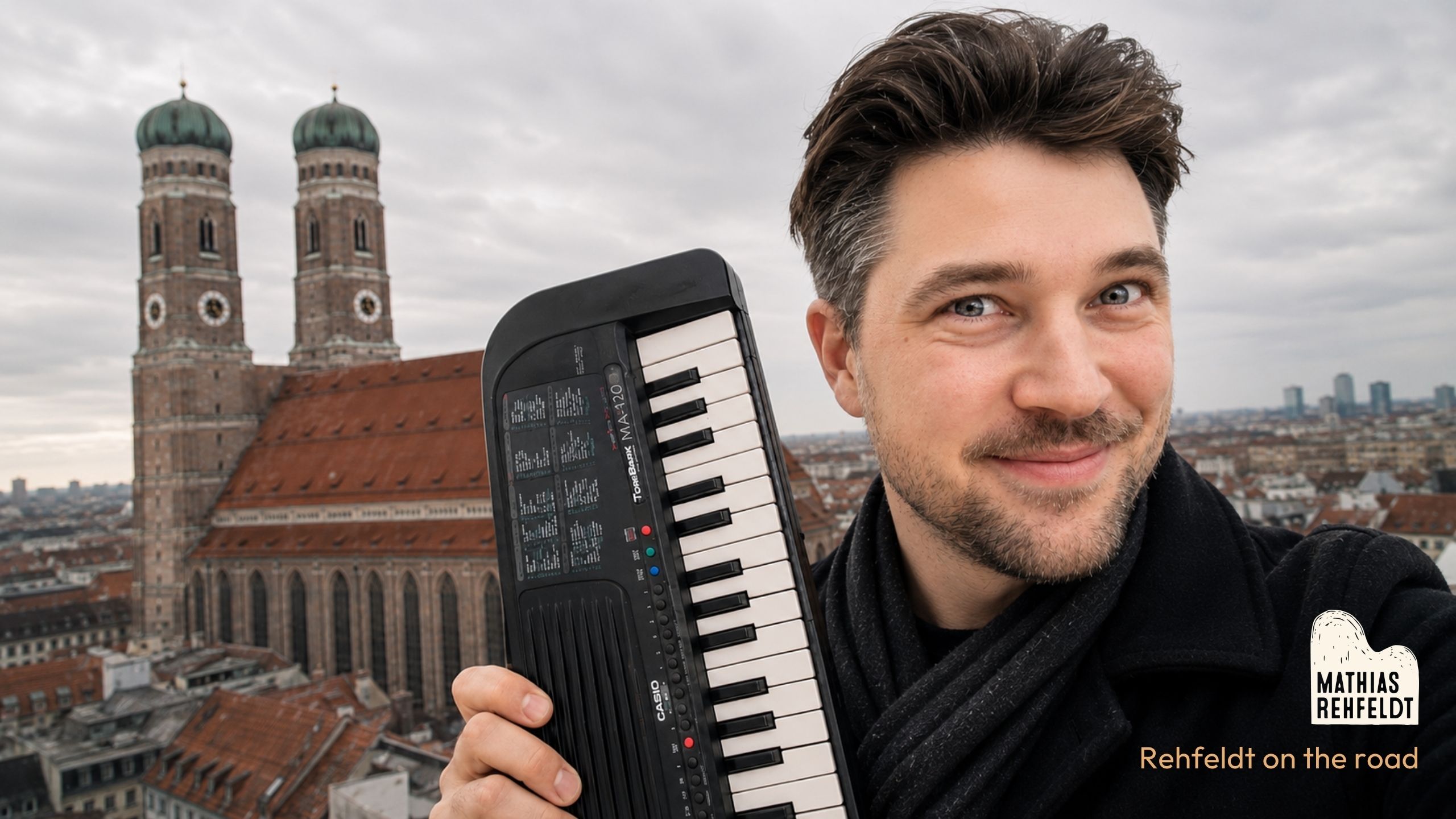
Back home I went down to the basement, to the cupboard where I keep the things I once thought I would need — an autoharp I never actually used for anything, that kind of thing. And then I found the one object I really loved: a children's keyboard from the '90s, still in its original packaging, New Kids on the Block songbook included. Hold that up in a giant cathedral and you almost have to laugh. It was exactly the wrong instrument, which is what made it the right one.
Turning the sound into ashes
Finding the toy wasn't enough. The sound itself had to become ashes. That is where a multi-effect guitar pedal came in — nothing vintage, I just bought it — with a bitcrusher: an effect that takes the audio signal and destroys it into tiny bits, until there is basically nothing left but ashes. A cheap keyboard, crushed further into dust. That was the material.
The reverb nobody warns you about
Something nobody tells you about playing in a space that size: the reverb is the mightiest you can possibly imagine. The sound travels through the whole building once and comes back to you much later. It makes playing in sync almost impossible unless you really practice listening to each other. In a room like that, listening becomes the actual instrument.
There was one thing I had quietly worried about beforehand. An organ changes its pitch with the temperature of the room. The toy keyboard I brought is completely untunable. So whether the two would even agree on a pitch was more or less down to chance. In our case it worked — organ and toy keyboard sat together perfectly. It was the first time I felt genuinely comfortable performing the piece, the evening before the service.
Otherworldliness by design
You can't really capture the atmosphere of a service like this in a video. It surrounds you; it is three-dimensional in a way. And that is otherworldliness by design — these cathedrals were built not just to make you understand something, but to make you feel eternity. The whole evening I felt like I was in a constant dream state, turning the subject of the evening over in my head.
Psalm 90
The structure of the piece came from Psalm 90 — a very dark psalm. Reading it the first time, it felt crushing. But with my idea that Ash Wednesday isn't only about despair, but about using our time well, I wanted to give that thought more room than the original text probably intended. So I settled on a free-form shape. The first section moves towards the greatness and eternity of God, and then had to break directly into the unsettling part — that our own time on earth is not eternal. I made a point of disrupting the structure I had just established. The final section is very short in the original text, so I added a few lines of my own, to give the idea I cared about more space: that our limited time can find its meaning in something larger.
What stayed
The strange part came afterwards. I usually avoid subjects like death and decay, and in this service there was no escaping them. And yet when I went home I felt oddly calm — not exhausted, not crushed. More like I had gained something. Maybe that is exactly what this tradition is trying to do, which is a beautiful thing to witness.
One last thing. A few days later I came home and realised this keyboard might not be so obsolete after all — and it left me wondering whether everything just moves in circles. But that is a thought for another time.
The piece is called Psalm 90, for organ and toy keyboard.