← All vlogs

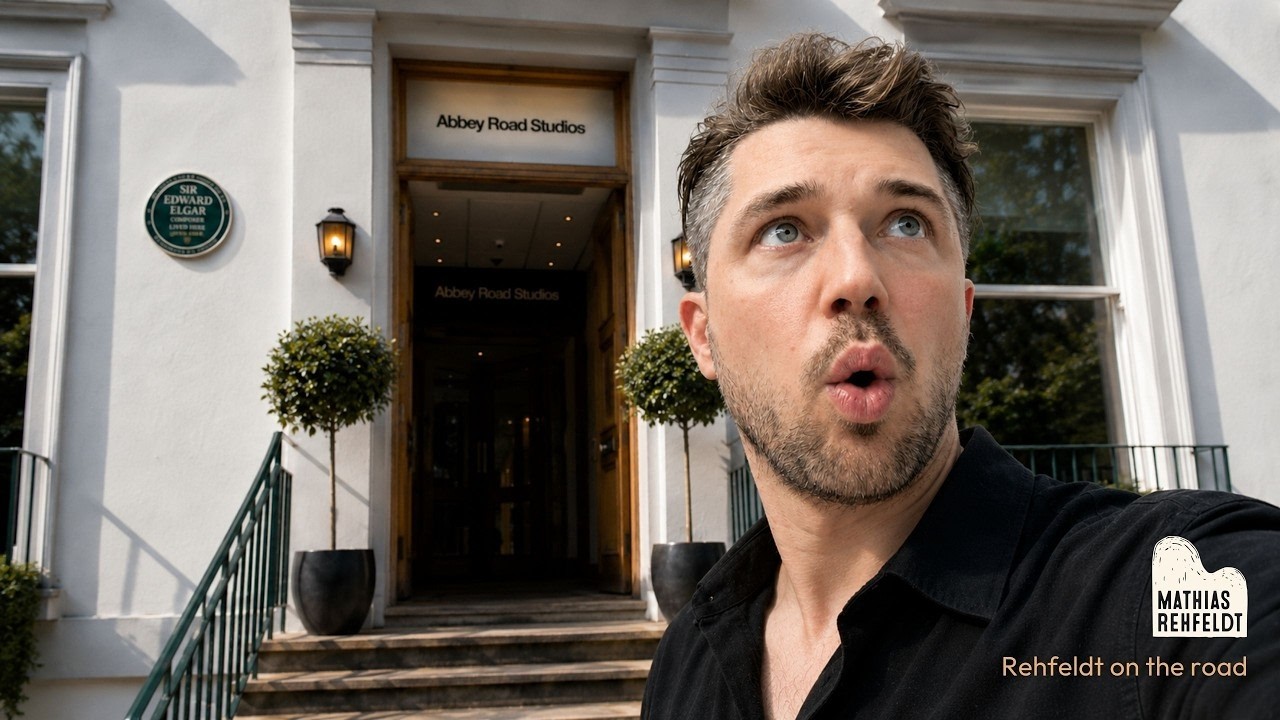
Recording at Abbey Road Studios

Producing an orchestral session at Abbey Road Studios with the Philharmonia Orchester in Studio 1 — and writing a new piece on the spot when the vocalist's visa got stuck in Sri Lanka.

Recording at Abbey Road Studios — Vlog-Thumbnail

Listen to the track that emerged: »Unwasting Time« on Spotify · Apple Music

EN Show the full story (English)

Why Abbey Road

For this episode I travelled to London to produce an orchestral recording session at Abbey Road Studios — the room where the London Symphony Orchester first recorded under Sir Edward Elgar in 1931, and where the Beatles tracked more than a hundred songs in Studio 2. Pink Floyd, Queen, Oasis, Radiohead, John Williams. For about fifteen years now Abbey Road has been listed as English Heritage, which means the building itself is protected by the government.

This time I wasn't writing the music myself. I was asked to guide and produce the session for another composer, working with the Philharmonia Orchester in Studio 1 — the big room used for orchestral recordings. The episode walks through what producing a session like this actually involves: setting up close mics and room mics to capture an orchestra, working with Abbey Road's vintage microphone collection, and why the room itself shapes the sound as much as the orchestration does.

The room as instrument

For those who don't spend their days in music production: it makes an enormous difference which room you record an orchestra in. The room is less a container for the musicians than a co-player. The Philharmonia in Studio 1 was a breathtaking experience — the quality of the playing, and the way the room shaped what came back through the speakers.

Abbey Road has probably one of the best collections of microphones in the world. Microphones are not like most other technology: they don't get outdated. Vintage mics get more expensive over time because they get harder to find. The studio owning a large collection of those mics is part of what makes Abbey Road expensive — and unique.

Studio 2 — the Beatles room

While the crew kept setting up Studio 1, I took a longer detour through Studio 2. This is the room where the Beatles recorded over a hundred songs. It hasn't changed since then. It looks exactly the way you know it from old photographs and films. Walking into it as someone who grew up on this music is a slightly strange experience.

When the plan falls apart

After the orchestra session we had booked additional time to track lead vocals through Abbey Road's microphone collection. That was the plan. Our singer is a Russian passport holder living in the Maldives, and his visa for the UK had been requested weeks in advance — but his passport was still sitting at the British Embassy in Colombo, Sri Lanka, where his priority visa application had stalled.

While we were in the air to London, he was sitting in a hotel in Colombo, day eighteen, with no end in sight. Best case: he arrives last minute and we record. Worst case: three hours of one of the most expensive studios in the world, completely empty.

"Unwasting Time"

Worst case happened. So instead of letting the time evaporate I sat down at the piano in the studio and started writing a new piece on the spot, using the orchestra recording, a piano take, and incidental sounds we'd captured live in the room — clicking microphones, the air of the hall, small breaths. The track that came out of this is called Unwasting Time.

Producing vocals from a different continent

This still didn't solve the original problem: we didn't have the vocals. Sri Lanka is not exactly known for big music studios, but we found one in Colombo — decent equipment, no vintage Abbey Road mics, but a team that worked their hearts out and basically saved the session. We tracked the vocals remotely over Zoom, with our engineer in Munich and the singer in Colombo. The result wasn't Abbey Road, but it was the right call: a finished record instead of a broken plan.

What stayed

Two things stayed with me from this trip. One is how much the room genuinely shapes the orchestra — close mics and room mics don't average out, they hold a tension that you only get with a specific architecture and a specific microphone collection. The other is that the most useful skill on a session like this isn't the music: it's deciding, in real time, what to do when the original plan disappears.

The orchestral album we were producing — Heaven on Earth, recorded for VELAA — can be streamed on Spotify.

DE Beschreibung auf Deutsch anzeigen

Warum Abbey Road

Für diese Folge bin ich nach London gereist, um eine Orchester-Recording-Session in den Abbey Road Studios zu produzieren — dem Raum, in dem das London Symphony Orchester 1931 erstmals unter Sir Edward Elgar aufgenommen hat, und in dem die Beatles über hundert Songs in Studio 2 eingespielt haben. Pink Floyd, Queen, Oasis, Radiohead, John Williams. Seit etwa fünfzehn Jahren ist Abbey Road offiziell als English Heritage geführt — das Gebäude steht also unter Denkmalschutz.

Diesmal habe ich nicht meine eigene Musik geschrieben. Ich war engagiert, die Session für einen anderen Komponisten zu betreuen und zu produzieren — mit dem Philharmonia Orchester in Studio 1, dem großen Raum für Orchester-Aufnahmen. Die Folge zeigt, was so eine Produktion tatsächlich bedeutet: Close-Mikros und Raum-Mikros aufstellen, mit Abbey Roads Vintage-Mikrofonsammlung arbeiten, und warum der Raum den Klang mindestens so prägt wie die Orchestrierung selbst.

Der Raum als Instrument

Für alle, die nicht den ganzen Tag in der Musikproduktion stecken: es macht einen enormen Unterschied, in welchem Raum man ein Orchester aufnimmt. Der Raum ist weniger Behälter für die Musiker als Mitspieler. Das Philharmonia in Studio 1 war atemberaubend — die Qualität des Spiels und die Art, wie der Raum den Klang zurückwarf.

Abbey Road besitzt vermutlich eine der besten Mikrofonsammlungen der Welt. Mikrofone funktionieren anders als die meiste andere Technik — sie veralten nicht. Vintage-Mikrofone werden mit der Zeit teurer, weil sie immer schwerer zu finden sind. Dass das Studio eine große Sammlung davon besitzt, ist Teil dessen, was Abbey Road teuer macht — und einzigartig.

Studio 2 — der Beatles-Raum

Während die Crew Studio 1 aufgebaut hat, habe ich mir Studio 2 angesehen. Hier haben die Beatles über hundert Songs aufgenommen. Der Raum hat sich seither nicht verändert. Er sieht genauso aus wie auf den alten Fotos und in den Filmen. Für jemanden, der mit dieser Musik aufgewachsen ist, ein seltsames Erlebnis, da reinzugehen.

Wenn der Plan zusammenbricht

Nach der Orchester-Session hatten wir zusätzliche Zeit gebucht, um Lead-Vocals durch Abbey Roads Mikrofonsammlung aufzunehmen. Das war der Plan. Unser Sänger ist Russe, lebt auf den Malediven, und sein UK-Visum war Wochen vorher beantragt — aber sein Pass lag noch in der britischen Botschaft in Colombo, Sri Lanka, wo sein Priority-Antrag stecken geblieben war.

Während wir nach London flogen, saß er in Colombo im Hotel — Tag achtzehn, ohne Aussicht auf Bewegung. Bester Fall: er kommt last minute und wir nehmen auf. Schlechtester Fall: drei Stunden in einem der teuersten Studios der Welt, komplett leer.

»Unwasting Time«

Es kam zum schlechtesten Fall. Statt die Zeit verstreichen zu lassen, habe ich mich ans Klavier im Studio gesetzt und auf der Stelle ein neues Stück geschrieben — mit der Orchester-Aufnahme, einer Klaviereinspielung und Geräuschen, die wir live im Raum aufgenommen hatten: klickende Mikrofone, die Luft des Saals, kleine Atemzüge. Der Track, der dabei rauskam, heißt »Unwasting Time«.

Vocals von einem anderen Kontinent produzieren

Damit war das ursprüngliche Problem nicht gelöst — wir hatten immer noch keine Vocals. Sri Lanka ist nicht gerade bekannt für große Musikstudios, aber wir haben eines in Colombo gefunden. Vernünftiges Equipment, keine Abbey-Road-Vintage-Mikros, aber ein Team, das alles gegeben und damit die Session gerettet hat. Wir haben die Vocals per Zoom aufgenommen, mit dem Tonmeister in München und dem Sänger in Colombo. Das Ergebnis war nicht Abbey Road, aber es war die richtige Entscheidung: eine fertige Platte statt eines geplatzten Plans.

Was geblieben ist

Zwei Dinge sind mir von dieser Reise geblieben. Erstens, wie sehr der Raum tatsächlich den Klang eines Orchesters formt — Close-Mikros und Raum-Mikros mitteln sich nicht aus, sondern halten eine Spannung, die nur diese spezielle Architektur in Kombination mit dieser Mikrofonsammlung erzeugen kann. Zweitens, dass die wichtigste Fähigkeit auf einer Session wie dieser nicht die musikalische ist — sondern in Echtzeit entscheiden zu können, was zu tun ist, wenn der ursprüngliche Plan zerfällt.

Das Orchester-Album, das wir produziert haben — Heaven on Earth für VELAA — kannst du auf Spotify streamen.

Watch on YouTube · subscribe if you want more behind-the-scenes from sessions like this.