← All vlogs

This Church Was Built to Confuse You

I was asked to write a piece about Gaudí's Sagrada Família — and then perform it inside its complete opposite: a church of raw concrete in Lucerne, built to feel like a cave.

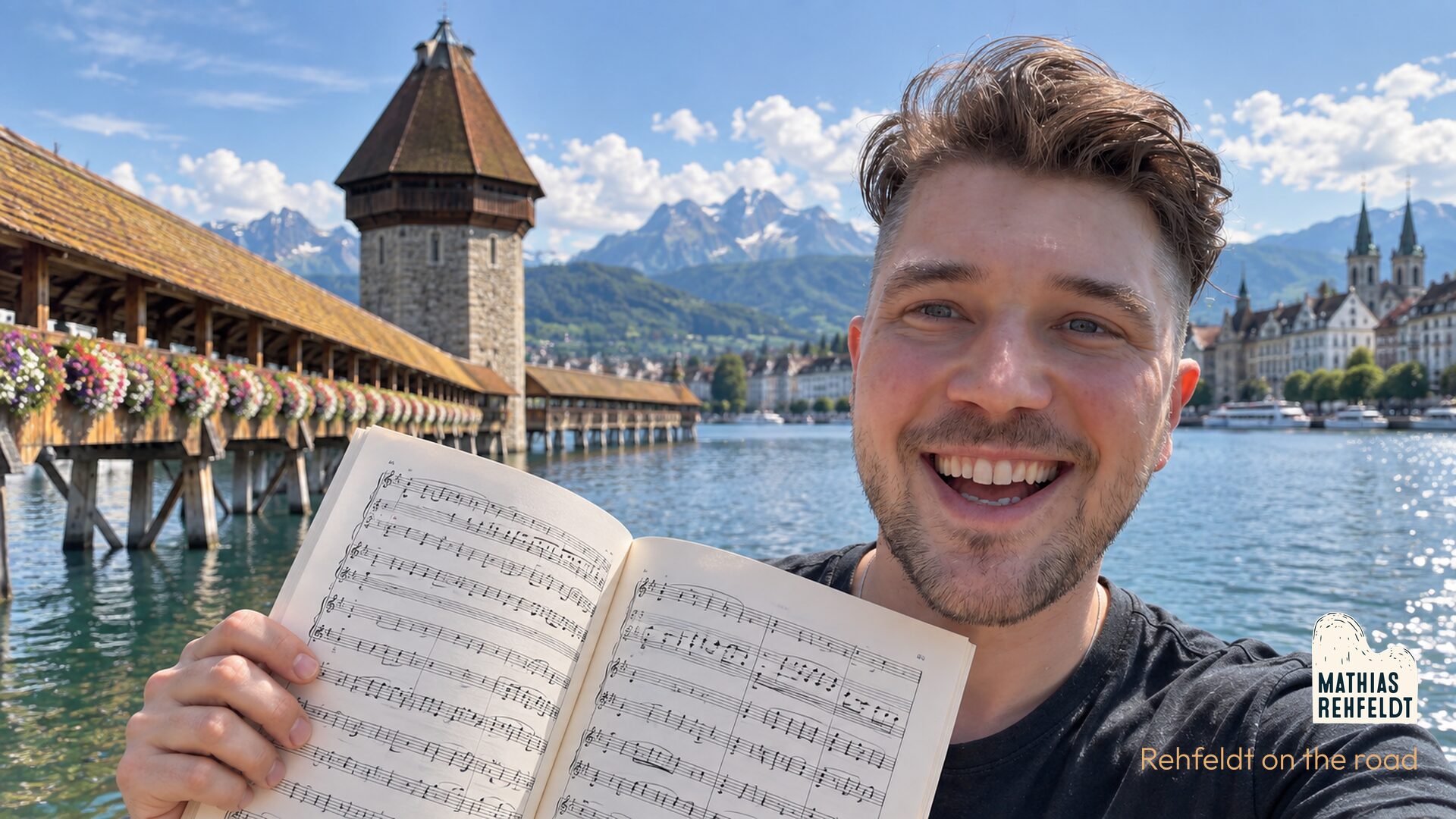
This Church Was Built to Confuse You — Vlog-Thumbnail
EN Show the full story (English)

A commission, and the wrong church

Lucerne has the Hofkirche, which holds one of the most interesting pipe organs in Switzerland. That is not where I played. I had been asked to write a piece for Lucerne and perform it there — organ and electronics, as usual, but this time with strings as well — and the concert was in St. Johannes: a church from 1970, built entirely out of raw concrete.

A building designed to confuse you

Brutalism is architecture built on being honest about material. A concrete wall looks like a concrete wall, not like something else. A steel beam looks like a plain industrial steel beam. I adore it. And this building is designed to be confusing, with full intent — the architect wanted it to feel like a cave, a place to take cover in. You notice the second you try to leave again: the door you came in through looks exactly like every other door, so you turn around once and it is gone. There are about five doors in that room and none of them looks like a main entrance. I picked the wrong one on camera. Works as intended, I guess.

Gaudí, who did the exact opposite

The piece was supposed to be about the Sagrada Família in Barcelona — Gaudí, and more or less the opposite of everything around me. He used materials so that they look like something else. A forest made of stone pillars. Arches found by hanging weighted strings upside down and copying the shape they fell into. Everything is taken from nature and then built from a material you would never expect. That transformation is the part that stayed with me.

An organ you have to pull by hand

The organ in St. Johannes is completely mechanical. Nothing can be saved, nothing is preset. Every stop has to be pushed or pulled by hand while the piece is running.

How do you turn that logic into music?

While writing I kept asking myself how to transfer Gaudí's method into sound. I ended up with aleatoric writing — chance. Like the weighted strings: you set it up, and you do not know what shape it will take. The trick is the boundaries. You do not tell players to do whatever they want, you give them a direction. That is also how improvisation works for me: I limit myself, and what comes out is better than if I were completely free.

Two strangers and one iPad

Writing like that works best when you know the musicians well. I did not — I had never met them. And I have noticed over the last years that people tend to have strong opinions about my music: some really hate it, some love it. I was hoping for the second kind. In an orchestra you can dislike a piece and still play what is on the page. If you have to improvise inside something you do not like, it will probably not end well.

They turned out to be a married couple, playing from a single iPad — partly because the score is a bit complicated, and with only your own part it gets harder to find your way through it. I liked them immediately. We had a few things to clarify at the start, and then it went much faster than I had expected.

"Mathias, the organ is simply too loud"

The pastor said it during the rehearsal. I had not heard it, because from the organ bench you sit in a completely different sound — it blows into both ears from the sides, so up there it is always too loud. The problem was the balance: the organ simply rolled over the strings. I took stops out and closed the swell shutters a little, but that only affects part of the instrument. Better. Still not good.

The night before

I went back to the hotel with that thought stuck in my head: still too loud, and people would dislike the whole piece because they would never hear what it was trying to do. It would simply sound wrong. I woke up about five times that night.

Half an organ, fifteen minutes before

The next morning I got to the church early with one idea: use half the organ, keep the shutters closed, and leave the main division out entirely. It is not a big instrument, so carrying a full sound on half of it should not work. When the strings arrived I told them we had to test it quickly, because the concert started in about fifteen minutes. We tested it. I had expected a painful compromise, and I did not miss a single thing. It simply worked, and it sounded great.

The concert

The programme alternated readings about the Sagrada Família with the music, which is also why the lighting looked so much like the photographs everyone knows of Gaudí's interior — they did that really well. My movements sat between the reading sections, each one built on a part of the text. So next to the chance-based material taken from nature, I kept everything else strict and precise.

The church was packed, which I had not expected on a Sunday morning.

A cave and a stone forest

Halfway through I was still wondering why we were presenting a piece about the Sagrada Família in a building that has nothing to do with it. The longer I sat with it, the less sure I got. Both imitate nature, each in its own way: here a cave, a grotto, in completely honest material; there a dense, light-filled wood made of stone. Maybe they have more in common than I first thought. I would like to hear what you think about that.

Either way, it was a beautiful experience again — it always is when you get out of the studio and perform somewhere live.

The piece is called Sagrada, for organ, electronics, violin and cello. It was written for this matinée and premiered there on 10 May 2026, with Lisa Schatzman (violin) and Beni Santora (cello), readings by Walter Sigi Arnold and words by Herbert Gut.

DE Beschreibung auf Deutsch anzeigen

Ein Auftrag, und die falsche Kirche

In Luzern steht die Hofkirche, in der eine der interessantesten Orgeln der Schweiz hängt. Dort habe ich nicht gespielt. Ich war gebeten worden, ein Stück für Luzern zu schreiben und dort aufzuführen — für Orgel und Elektronik wie üblich, diesmal aber zusätzlich mit Streichern — und das Konzert war in St. Johannes: einer Kirche von 1970, komplett aus Sichtbeton.

Ein Gebäude, das dich verwirren soll

Brutalismus ist eine Architektur, die auf Ehrlichkeit im Material beruht. Eine Betonwand sieht aus wie eine Betonwand und nicht wie etwas anderes. Ein Stahlträger sieht aus wie ein ganz normaler Industrie-Stahlträger. Ich mag das sehr. Und dieses Gebäude ist mit voller Absicht verwirrend gebaut — der Architekt wollte, dass es sich anfühlt wie eine Höhle, in der man Schutz findet. Man merkt es in dem Moment, in dem man wieder hinaus will: Die Tür, durch die man hereingekommen ist, sieht aus wie jede andere Tür, man dreht sich einmal um und sie ist weg. Es gibt ungefähr fünf Türen in diesem Raum, und keine davon sieht aus wie ein Haupteingang. Ich habe vor der Kamera die falsche erwischt. Funktioniert also wie geplant.

Gaudí, der genau das Gegenteil gemacht hat

Das Stück sollte von der Sagrada Família in Barcelona handeln — Gaudí, und damit ziemlich genau das Gegenteil von allem, was um mich herum stand. Er hat Materialien so verwendet, dass sie aussehen wie etwas anderes. Ein Wald aus Steinsäulen. Bögen, die er gefunden hat, indem er beschwerte Schnüre aufgehängt, umgedreht und ihre Form übernommen hat. Alles ist der Natur entnommen und dann aus einem Material gebaut, das man nie erwarten würde. Diese Verwandlung ist der Teil, der bei mir hängen geblieben ist.

Eine Orgel, die man von Hand zieht

Die Orgel in St. Johannes ist rein mechanisch. Nichts lässt sich speichern, nichts ist voreingestellt. Jedes Register muss während des Stücks von Hand gezogen oder geschoben werden.

Wie überträgt man diese Logik in Musik?

Während des Schreibens habe ich mich ständig gefragt, wie sich Gaudís Methode in Klang übersetzen lässt. Herausgekommen ist aleatorisches Schreiben — Zufall. Wie die beschwerten Schnüre: Man baut es auf und weiß nicht, welche Form daraus wird. Der Punkt sind die Grenzen. Man sagt den Spielenden nicht, sie sollen machen, was sie wollen, man gibt ihnen eine Richtung. So funktioniert für mich auch Improvisation: Ich schränke mich ein, und das Ergebnis wird besser, als wenn ich völlig frei wäre.

Zwei Fremde und ein iPad

So zu schreiben funktioniert am besten, wenn man die Musiker gut kennt. Das war nicht der Fall — ich hatte die beiden nie getroffen. Und ich habe in den letzten Jahren gemerkt, dass die meisten Leute eine sehr klare Meinung zu meiner Musik haben: Manche hassen sie wirklich, manche lieben sie. Ich hoffte auf die zweite Sorte. Im Orchester kann man ein Stück nicht mögen und trotzdem spielen, was in den Noten steht. Wenn man in etwas improvisieren muss, das einem nicht gefällt, wird das vermutlich nichts.

Es stellte sich heraus, dass die beiden ein Ehepaar sind und sogar vom selben iPad spielen — auch, weil die Partitur etwas kompliziert ist und man sich mit nur einer Stimme schwerer zurechtfindet. Ich mochte sie sofort. Am Anfang gab es ein paar Dinge zu klären, danach ging es deutlich schneller, als ich gedacht hatte.

„Mathias, die Orgel ist einfach zu laut"

Das sagte der Pfarrer während der Probe. Ich hatte es nicht gehört, weil man auf der Orgelbank in einem völlig anderen Klang sitzt — es bläst von beiden Seiten in die Ohren, dort oben ist es immer zu laut. Das Problem war die Balance: Die Orgel hat die Streicher schlicht zugedeckt. Ich habe Register herausgenommen und den Schweller ein Stück geschlossen, aber das betrifft nur einen Teil des Instruments. Besser. Immer noch nicht gut.

Die Nacht davor

Ich bin ins Hotel zurück, mit dem Gedanken fest im Kopf: immer noch zu laut, und die Leute würden das ganze Stück ablehnen, weil sie nie hören würden, was es eigentlich macht. Es würde einfach falsch klingen. In dieser Nacht bin ich ungefähr fünfmal aufgewacht.

Eine halbe Orgel, fünfzehn Minuten vorher

Am nächsten Morgen war ich früh in der Kirche, mit einer Idee: nur die halbe Orgel benutzen, den Schweller geschlossen lassen und das Hauptwerk ganz weglassen. Es ist kein großes Instrument, einen vollen Klang aus der Hälfte zu tragen dürfte eigentlich nicht funktionieren. Als die Streicher kamen, sagte ich, wir müssten das schnell testen, weil das Konzert in etwa fünfzehn Minuten beginnt. Wir haben es getestet. Ich hatte einen schmerzhaften Kompromiss erwartet, und mir hat nichts gefehlt. Es hat einfach funktioniert und klang großartig.

Das Konzert

Das Programm wechselte zwischen Lesungen über die Sagrada Família und der Musik — daher sah auch das Licht so aus wie auf den bekannten Bildern von Gaudís Innenraum, das war wirklich gut gemacht. Meine Sätze standen zwischen den Leseteilen, jeder auf einem Abschnitt des Textes aufgebaut. Neben dem aus der Natur abgeleiteten Zufallsmaterial habe ich alles andere bewusst streng und präzise gehalten.

Die Kirche war voll, womit ich an einem Sonntagmorgen nicht gerechnet hatte.

Eine Höhle und ein Steinwald

Auf der Hälfte habe ich mich immer noch gefragt, warum wir ein Stück über die Sagrada Família in einem Gebäude aufführen, das nichts damit zu tun hat. Je länger ich darüber nachdachte, desto unsicherer wurde ich. Beide bilden Natur nach, jedes auf seine Weise: hier eine Höhle, eine Grotte, in völlig ehrlichem Material; dort ein dichter, lichtdurchfluteter Wald aus Stein. Vielleicht haben sie mehr gemeinsam, als ich zuerst dachte. Ich würde gern hören, wie ihr das seht.

So oder so war es wieder eine schöne Erfahrung — das ist es immer, wenn man aus dem Studio herauskommt und irgendwo live spielt.

Das Stück heißt Sagrada, für Orgel, Elektronik, Violine und Violoncello. Es wurde für diese Matinee geschrieben und dort am 10. Mai 2026 uraufgeführt, mit Lisa Schatzman (Violine) und Beni Santora (Violoncello), Lesung Walter Sigi Arnold, Texte Herbert Gut.

Watch on YouTube · subscribe if you want more behind-the-scenes from projects like this.